
























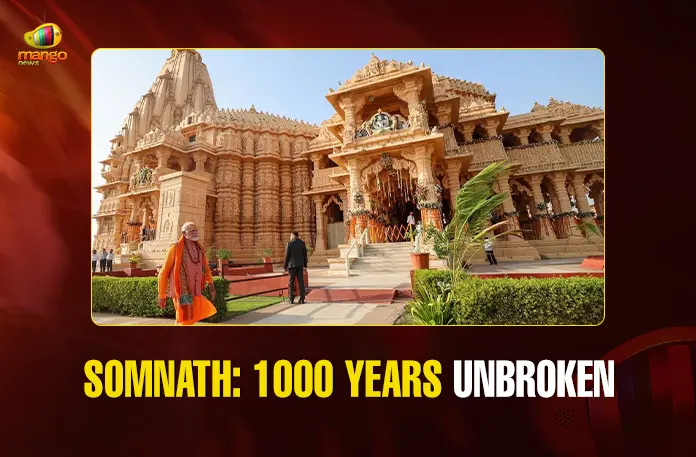
Prime Minister Narendra Modi has marked a historic milestone in India’s civilisational story, reflecting on the 1,000-year legacy of the Somnath Temple — a journey marked by destruction, reconstruction and unwavering faith. In a blog and social media posts today, the Prime Minister described Somnath not just as an ancient shrine, but as a powerful symbol of India’s spiritual strength and cultural resilience.
Located at Prabhas Patan on Gujarat’s western coast, the Somnath Temple stands as the first of the twelve Jyotirlingas in Hindu tradition and has drawn devotees from across India for centuries. Modi highlighted that 1026 AD marked the first recorded attack on the temple by Mahmud of Ghazni, a violent assault aimed more at obliterating a cultural and spiritual icon than at devotion. Historical accounts recount widespread destruction and loss of life during that campaign.
Despite repeated invasions over the centuries, generations rebuilt Somnath each time, turning it into a powerful symbol of India’s indomitable spirit. Prime Minister Modi stressed that the temple’s legacy lies not in its destruction, but in the courage of those who restored it repeatedly, especially after India’s Independence. Reconstruction efforts in the mid-20th century, led by national leaders including Sardar Vallabhbhai Patel and inaugurated in 1951, gave the temple its modern form.
The Prime Minister drew a parallel between Somnath’s endurance and India’s present-day global emergence, suggesting that the same unbroken spirit that preserved this sacred site now fuels the nation’s progress in technology, culture and global influence.
As India commemorates both a millennium since the first attack and 75 years of the temple’s post-Independence revival, Somnath stands today not merely as a monument, but as a living emblem of faith, unity and national identity.