














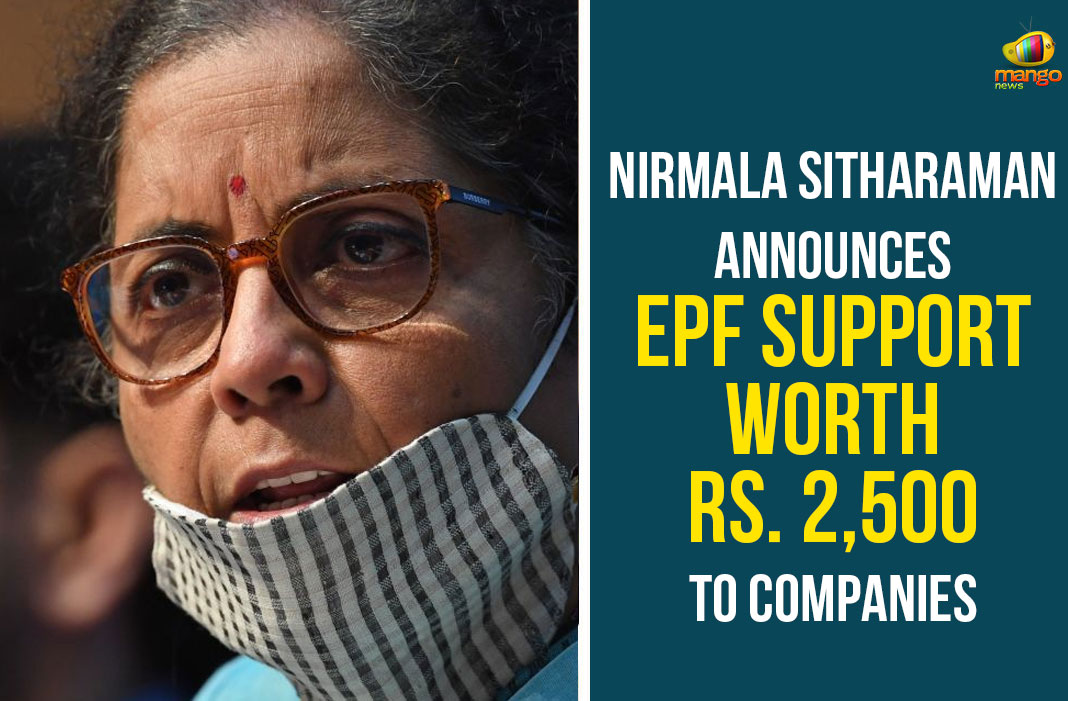
Nirmala Sitharaman, the Finance Minister of India, on the 13th of May, announced the distribution of the financial package of Rs.20 lakh crores to deal with the pandemic crisis.
Ms. Sitharaman announced Rs. 2,500 crores as Employees’ Provident Fund (EPF) support for businesses, workers for three more months. The Central Government extended the EPF support for salary months of March, April and May, which has now been extended by another three months June, July and August.
Under the Pradhan Mantri Garib Kalyan Package (PMGKP), the Finance Minister announced a payment of 12 % of employer and 12 % of employee contributions into the EPF accounts of the eligible establishments.
The scheme will provide liquidity relief of Rs 2,500 crore to 3.67 lakh establishments, benefitting 72.22 lakh employees in India.
The Finance Minister announced reduction of statutory Provident Fund (PF) contribution of both employer and employee to 10 % from the existing 12 % across all establishments covered by the EPFO for the next three months.
The Central Public Sector Enterprises (CPSEs) and state Public Sector Undertakings (PSUs) would, however, continue to contribute 12 per cent as employer contribution.
The scheme for lower EPF contribution will be applicable to workers who are not eligible for 24 % EPF support under the PM Garib Kalyan Package and its extension.
This scheme is estimated to provide relief to about 6.5 lakh establishments covered under the EPFO and benefit about 4.3 crore such employees. It will provide liquidity of Rs 6,750 crore to employers and employees over three months.
In addition, the Government extended the deadline for settling tax disputes under the Vivad se Vishwaas scheme without paying any interest and penalty to December 31, 2020 from June 30, 2020.
In a major relief for taxpayers amid the coronavirus pandemic, the Centre on Wednesday announced the extension of the due date for filing income tax returns for the financial year 2019-20.
The announcements were made to help the MSMEs and small businesses and working class people in India.
Stay tuned for further updates.
Source : IANS.