
























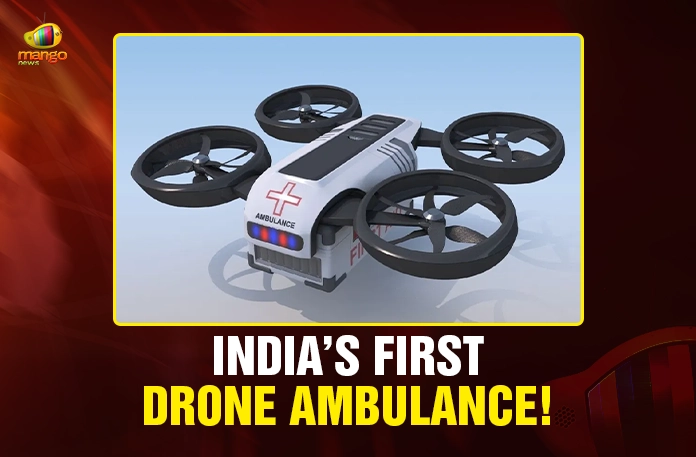
In a landmark step toward transforming emergency medical response, the Government of Andhra Pradesh has joined hands with the Dr. Kalam Advanced UAV Research Centre (CASR) at Anna University, Chennai, to build the world’s first long-range, human-carrying drone ambulance — a project slated for its inaugural test flight in the first week of May 2026.
Driven by Chief Minister N. Chandrababu Naidu’s vision to overhaul critical healthcare access across challenging terrains, the initiative aims to make rapid aerial medical transport a reality, especially in remote and underserved regions where conventional ambulances struggle with time and infrastructure barriers.
Designed for Life-Saving Missions
The next-generation unmanned aerial vehicle (UAV) will carry a payload of up to 150 kg, enabling it to transport a patient or essential medical cargo such as blood units, medicines, and diagnostic samples. Capable of flying continuously for about 90 minutes at speeds of 50–60 km/h and altitudes between 1,000 and 1,200 feet, the drone’s range is expected to span approximately 50 km.
Safety and Technology at the Forefront
Safety systems are integral to the design: redundant flight control, autonomous emergency landing capabilities, and real-time tracking via a Unified Traffic Management (UTM) system will help manage flights beyond visual line of sight (BVLOS). Indian regulators are also working on frameworks to safely integrate these missions into the airspace.
Looking ahead, planners envisage enhancing the drone’s capacity to include space for a trained paramedic onboard, further boosting patient care during aerial transfers. If successful, this innovation could redefine emergency response protocols in India and set a global precedent for airborne medical transport.